advent, the tender season

dsc_6757-e1543348186623.jpg
DSC_6778

DSC_6778

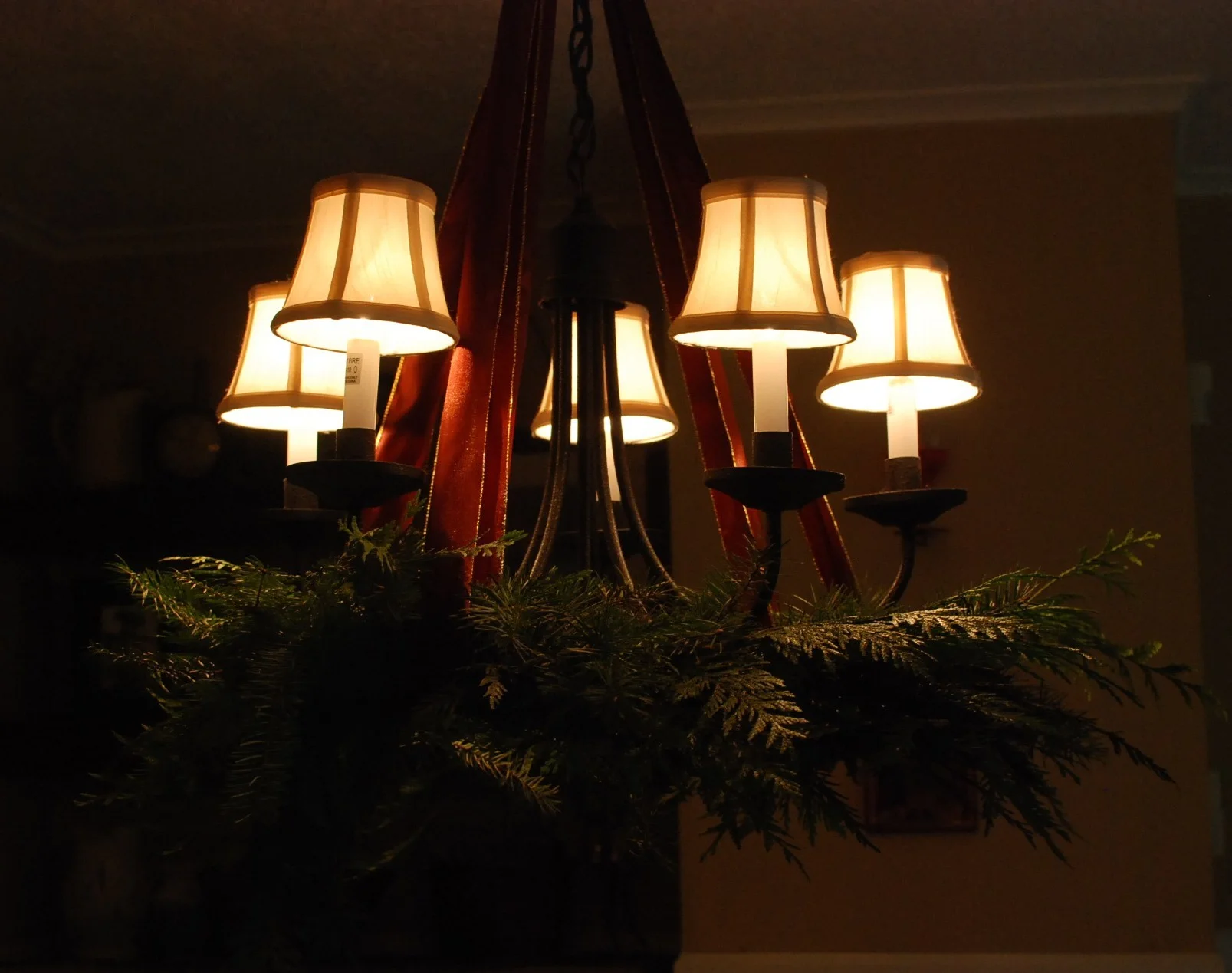
Gertrud Mueller Nelson says that Advent comes to us when "Nature seems asleep. The season is dark, and all that is becoming is hidden from our sight."  Much of the church year has a martial, triumphant feel, but Advent, I think,  is a woman's season - deeply quiet, patient, and tender - and that is probably why it draws me so.  It is a time of waiting, nurturing, and anticipating, more than celebrating and doing; the antithesis, almost, of the cultural Christmas season.

In order to enter into this contemplative time (which for us begins on December 2nd) it helps me to work backward mentally from Christmas and imagine how I want the arc of the season to go.  Like many people, I grew up celebrating Christmas as a stressful, exhausting month of spending that culminates in one bloated and excessive day.  When I began to understand the cycle of the church year and how it was designed to focus the heart and mind, that pattern became very dissatisfying.  But because the pattern is so culturally ingrained and difficult to change, we found we had to opt almost completely out of parts of it in order to regain our perspective.  (We are still in the process of shedding old expectations and habits, so what I share here is just a snapshot of our process, not an answer for everyone.)

Except for the young children, we do not give many gifts at Christmas.  Each year is a little different, but for the most part, we have found this area to be the hardest to change and to maintain any kind of balance.  Buying a gift for one person inevitably leads to buying for a second, then the worry about whether the gifts are equally valuable, and will someone else's feelings be hurt or will that person feel slighted and if we're buying this for one person shouldn't we also buy it for that other one and oh no! I forgot your Aunt Martha!  It's relentless.  So we began to opt out from all of it.  Some years, we pool our money and rent a beach house as a family.  Some years we just spend the day together.  But until we feel free of the consumer pressure and hysteria of it all, we will not add gifts back into our Christmas celebrations.

As you can probably imagine, once you remove most of the pressure of gift-shopping/buying/wrapping/presenting you have released a lot of time, money, and energy and it's easier to consider a month of simple, contemplative practices.

Our Advent was a little different when we had children at home.  We lit candles each night and read prayers and scriptures; we also unwrapped and read a different Christmas book each night; we kept a Jesse Tree and hung ornaments on it; we moved Mary and her donkey around a wooden wreath.  (Kortney outlines a really similar practice in her beautiful (free!) e-book. It has many more resources. I highly recommend it!)  Our children LOVED this time and it has been a little sad to move on from it, but that is the reality of life.  These days our Advent-keeping is much simpler.  I purchased four candle holders from Goodwill and some plain beeswax candles and I will make a little wreath with greens and succulents.  We'll light the week's candles and pray from The Divine Hours each night, maybe read from  Child In Winter.  Our church is holding weekly contemplative services on Wednesdays, so we'll go to some of those as well.  For me, Advent is a time when I reconnect with the idea of goodness and hope waiting to be born into the world, of the sacrificial love that Mary, Joseph, and Jesus all represent.  What am I bearing into this aching world?  In what ways am I loving outside myself?  Am I sharing God's love with others?  Are we as a family reflecting light and hope?   In what ways do I need God to heal and rebirth me?

In the still of Advent, the questions of the soul can begin to be answered.

*

It's not all contemplation though, we do celebrate a few days during the Advent season:  mainly St. Nicholas' Day, St. Lucy's Day and the Solstice.

St. Nicholas Day is December 6th and he is, of course, the inspiration for most of the Christmas mythology we have now.  He's a joyful, pure-hearted saint and we love taking time to remember him.  For years now, I have used this day to give books to my family.  I love, love, love to give books and I spend a lot of time thinking through the year what I'd like to share with each family member.  This is a tradition unique to our family, but one I hold very dear.  In addition, we are having a little party for friends this year.  In keeping with the St Nicholas traditions, we'll collect socks for the homeless and do a fun sock exchange and I ordered fair trade chocolate coins to hand out.

St. Lucy's Day (Santa Lucia) is December 13th.  This was an especially fun day to celebrate when our daughter was young.  Traditionally, the oldest daughter gets up early and makes saffron buns and coffee for the family and serves them while wearing a candle wreath on her head.  We never managed a candle wreath, but we will still do the saffron buns and coffee, of course!

Solstice is the longest night of the year and the beginning of winter and we typically observe it very simply by keeping the lights off and only using candles, accepting the darkness of the winter and the gradual return of the light.

*

creche

creche

Christmas itself is a full twelve days and there is plenty to celebrate there too,  (St John's day gets mulled wine!  Yay!) so I'll write more about Christmas as it nears.  It can be difficult with everyone else around decorating their hearts out, but we do wait until as close to Christmas Eve as possible to get our tree and decorate it.  I can't tell you how much I love waiting.  It makes the anticipation of Christmas day so much more exciting when all these little events slowly unfold each in their own time.  We'll bring out the creche around the same time as the tree, and start to slowly fill it with the various figures.  First Mary and Joseph, a few animals, then on Christmas Eve the angels and the star, the shepherds and their flock.  The wise men have to wait for January 6th - Epiphany! - but they are on their way too and sometimes they show up on a bookshelf or in another room, making their way to God in their own time and on their own path.

*

There are so many resources online to help you understand Advent and Christmas, but I hope this gives you an idea of what it can be like.  My main encouragement is to slow everything down and strip it back to something that feels life-giving and hopeful for your family - that's the whole point of this season anyway.  Please feel free to ask any questions!

Much love to you,

tonia

hara hachi bu

fw18harahachibu.jpg

The old generation Okinawans are among the longest lived people in the world.  They have a lot of tricks about how to accomplish this:  a sense of life-purpose, intimate family/friend connections, a simple diet based on plants, regular gentle exercise such as walking and gardening.  The other thing they practice is hara hachi bu - the idea of eating only until they are 80% full.  I don't know if you could find a concept more foreign to American culture.  We're a clean your plate so you can have dessert kind of people, an unbutton the top button of your jeans kind of people, not an I feel satisfied so I'll quit while I'm ahead kind of people.

I've been thinking about this concept for some time.  Not just about eating, but about consumption in general.  The science behind hara hachi bu is that it takes 20 minutes for the nerve endings in our stomachs to register we are full.  If we eat until we feel full, as most of us do, then we have already overeaten and stretched beyond our natural capacity.  Eventually we will need more food to create the satiated feeling we are looking for. (More food = more weight = poor health.)  It's the same with our money and our time, of course.  The level at which we are satiated rises with each new luxury we indulge in.  I used to be satisfied with grocery store coffee. Enough said.  My need to create tasks and fill my hours increases with my perception of my own importance.  How will I know I am valuable if I'm not complaining about too much to do and responding "Busy!" to every "How are you?"

Hara hachi bu says it is best for us if we take less than what we feel we need.   Our bodies can't tell us what we need in the moment we are consuming, so our minds must be wiser than our bodies.  What if I bought 20% less food at the grocery store?  Would that eliminate the last of the food waste we generate and be closer to what we actually need?  What if I only planned enough tasks for 80% of my day and left 20% for serendipity or naps?  What if we lived on 80% of our disposable income?  Bought only 8 of the 10 books I think I want? Committed to keeping 20% of our calendar free?

Maybe a practice like that would get me closer to the balance my mind and soul are continually seeking.

Do you have a hara hachi bu practice?  Id' love to hear your thoughts. 

becoming available to yourself

fw18-autumnmaple.jpg

Recently, I pulled out my journal to see if I could remember when I started working on this new novel.  I found the answer back in the July pages.  The months before I'd been wrestling with the balance between what I felt were two distinct callings.  One required availability, the other - writing - required isolation and focus.  I couldn't see how to make both of these callings work, so all through the month of June I am writing out an explanation to myself about what I think is the correct choice: availability.  The writing must not be important in the long run, I say to myself.  It's always about people, it's always about showing up.  In June, there is a sense of relinquishment.  I can remember the feeling of release, a certain peace.  Writing would wait.  Then in July, a succession of unexpected events.  These were small things:  conversations, decisions by friends, a gift from someone close, a paragraph in a book.  These were sudden and illuminating, like matches being struck in dark corners: Oh, I see.  By the end of that month, I had decided that I *must* write, even if it was just 250 words a day.  I would inch my way along both trajectories.  I told other people about my decision, committed myself, made it hard to back out.  I made it to 10,000 words, 15,000, 20,000.  At that point, the landscape began to shift.  Decisions were made apart from me, obligations, relationships sifted, time opened up in a new way.  There were more small things.  Every book I picked up - some I'd bought years before and left on the shelf only to randomly select them again now - was the story of a woman coming into her truth.  Every time I grabbed a magazine, it was a woman telling how she made the hard choice, how she chose her path and stuck with it even when it meant disappointing others.  Friends who all along had been counseling "availability, availability" began to say "it's time for something new."   I began to admit things in the journal I'd never allowed myself to say.  Things I wanted but hadn't given voice to.  In the space of four months everything heaved and buckled, became new ground.

What's interesting to me about all this is in hindsight, I'm not sure if the changes were  inevitable and I was just awakening to them, or if the changes came in response to my decisions.  When I look back, its almost as if this life had been lying in wait for me to choose it.  Each step I've taken has been met with a surge of reassurance, clarity, and confirmation.  But I sense that if I had not taken the steps...if I had stayed on the path I was already on, there would have been reassurance and confirmation there too.  I'm almost certain of it.  That scares me a little, to think I could have just gone on with what I knew and what felt comfortable, that life itself would have risen up and affirmed that choice too.  What might I have missed had I not taken the small messages, the little match flares that were revealing another way?  May Sarton suggests it:

"The gift turned inward, unable to be given, becomes a heavy burden, even sometimes a kind of poison. It is as though the flow of life were backed up."

I have felt this stagnation, an underground current pulsing, not allowed to find release.  When I think of so many women I know, I am struck by how their deep thoughtfulness, their tremendous strength and creativity is put to use holding relationships together, managing dysfunctional family members, being the emotional center of their homes or jobs or communities.  I cannot imagine where we'd be without such women, but I am also struck with the inequity of it.  What have we lost in terms of wisdom, art, culture, science, diplomacy, language, and much more by allowing ourselves to be available to everyone but our own selves?

It's something to think about.  Questions to ask ourselves in moments when we can be honest.  Step back, look.  What is pulsing underneath the surface?  What longing hasn't even been allowed the words to describe it?  What would you do if there was no one who needed your daily involvement?  There are seasons, certainly, when these longings and gifts have to take the background, but in my own life, they weren't just in the background, they were in a tight little box labeled "probably never" or "probably too late."  What about yours?  Are they somewhere they can be nurtured and watered even in a dormant season?

"And now we who are writing women and strange monsters

Still search our hearts to find the difficult answers,

Still hope that we may learn to lay our hands

More gently and more subtly on the burning sands." ~ May Sarton

Sending love and courage to all my brave-hearted friends today.

tonia     

overcoming resistance

I went to the gym for the first time in almost thirty years this morning.  I went with my husband, who has been asking me to come with him for almost as long.  It's the kind of thing he thinks will be "fun," and I think will be dreadful.  It wasn't dreadful.  Just as he'd promised, no one paid any attention to me as I learned how to operate the bike and the weight machines, and just as he'd promised, it was kind of fun to be there with him.  It wasn't until I was heading out of the gym and on the way home that I remembered why I'd stopped going to the gym in the first place.  I was 18 years old and terribly self-conscious of my body and my fitness level  - and my semi-regular visits to the facility were drawing attention from an older man.  I can remember him waiting outside, leaning up against the concrete wall with a water bottle in hand, asking me in that slow male drawl how my workout was, telling me with a glance up and down that I was looking pretty good.   It was the late 80's - and it was a man's world.  It never occurred to me to stand up for myself and tell him to go away, or to complain to the gym, or even alter my schedule.  I felt uncomfortable so I quit.  In the Christian subculture I grew up in, that was my role in the world: submit, yield, or get out of the way, and I did.I'm at midlife now and I ditched the ideology of the subculture a long time ago, but the muscle memory is still there.  Someone makes a demand on my time or emotional energy and I instantly assume it's my duty to meet it even when I am mentally certain I should be doing something else.  The limbs twitch with conditioned motion, thoughts race along the grooves of practiced belief, and dopamine arrives to validate the action. In the old days, I called this comfortable, assured feeling "peace."  Conforming provided its own reward - and kept me from growing into anything more.

I'm most vulnerable to this kind of reaction directly after I assert myself and declare my intentions.  I've come to expect that any new burst of personal determination signals not a season of productivity, but a major catastrophe looming in the wings.  As soon as I hit the gym, the creepy old guy shows up in the doorway demanding attention, plucking the strings of my ingrained responses, encouraging me to yield to his demands.

"Resistance," says Steven Pressfield in The War of Art, "obstructs movement only from a lower sphere to a higher. It kicks in when we seek to pursue a calling in the arts, launch an innovative enterprise, or evolve to a higher station morally, ethically, spiritually."

she makes it happen

she makes it happen

Learning to recognize Resistance can be complicated - especially when it comes to us wrapped in religion, ideology, and gender-roles.  Some people learn early to recognize and defy it, but for me and many others, it's a lifetime's work.  We get there one revelation, one deliberate, defiant act at a time.

We can claim the truth that we are makers, artists, builders, weavers, nurturers, truth-tellers, poets, and our work matters.

So go to the gym.

Show up for yourself.

Tell the creepy old man at the door to leave you the hell alone and mean it.  (If he sticks around, show up again anyway.  He'll get bored when he realizes he has no power to disturb or distract you. )

You can do this.  We can do this.  We owe it to ourselves - those selves that sat back, that let other people succeed, that fixed all the problems and carried all the burdens, that pushed down feelings and desires, that made dreams smaller so they didn't disturb anyone else.  We owe it to ourselves to grow our dreams and find a way and be faithful to what has always been real and true inside of us.  So let's do it, okay?

Love you, my friends.

tonia

rabbit and bone

43567.jpg
32487

32487

94222

94222

26154

26154

9202

9202

39831

39831

73954

73954

13624

13624

74287

74287

19075

19075

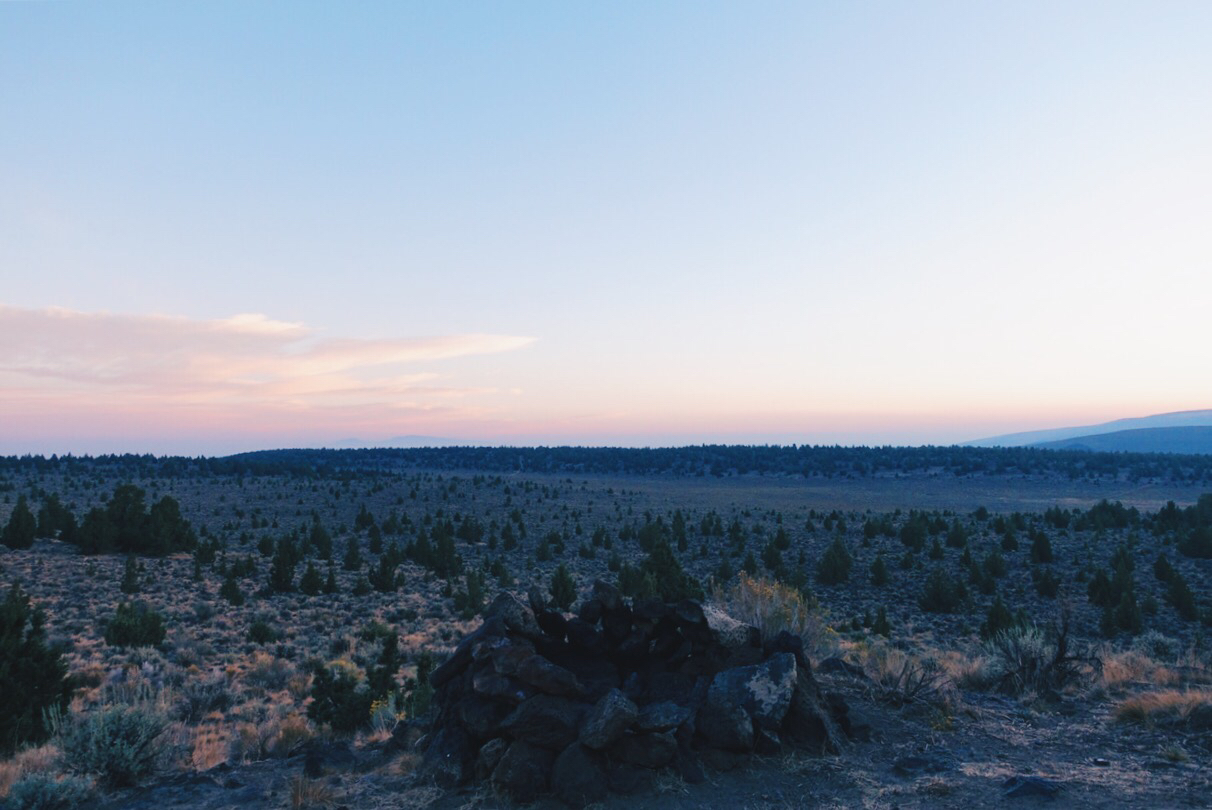
Night closes gently over the desert sky in a curtain of pink and amber.  The dark, when it comes, spreads slowly down, as if from the center of a dome, pushing at the last of the pale light, driving it into the horizon. Then the stars come out, hundreds of them, a sequined carpet unfurled against the blackness overhead.  In the middle of it all, the Milky Way, shimmering faintly, hinting at color - purple, blue, a thin shaft of gold.  There is almost no sound.  Somewhere out in the miles of open land around us there are creatures stirring, moths that flutter toward any hint of artificial light, coyotes after their rodent prey, cattle sighing and squirming, adjusting themselves to their prickly beds, but we hear none of it.  It is only the two of us, wrapped in blankets, puzzling out constellations in a whisper, watching for stars to fall.

It was my daughter’s idea to come.  A birthday gift, to write, to connect.  Out here we have no internet to call upon, no cell phones to hunch over.  There is each day, there is each other.

We write.  We read each other’s stories and talk through possible plot lines.  We agonize over edits and the stubbornness of characters. When the words begin to blur together, we go for walks. Together. Alone.

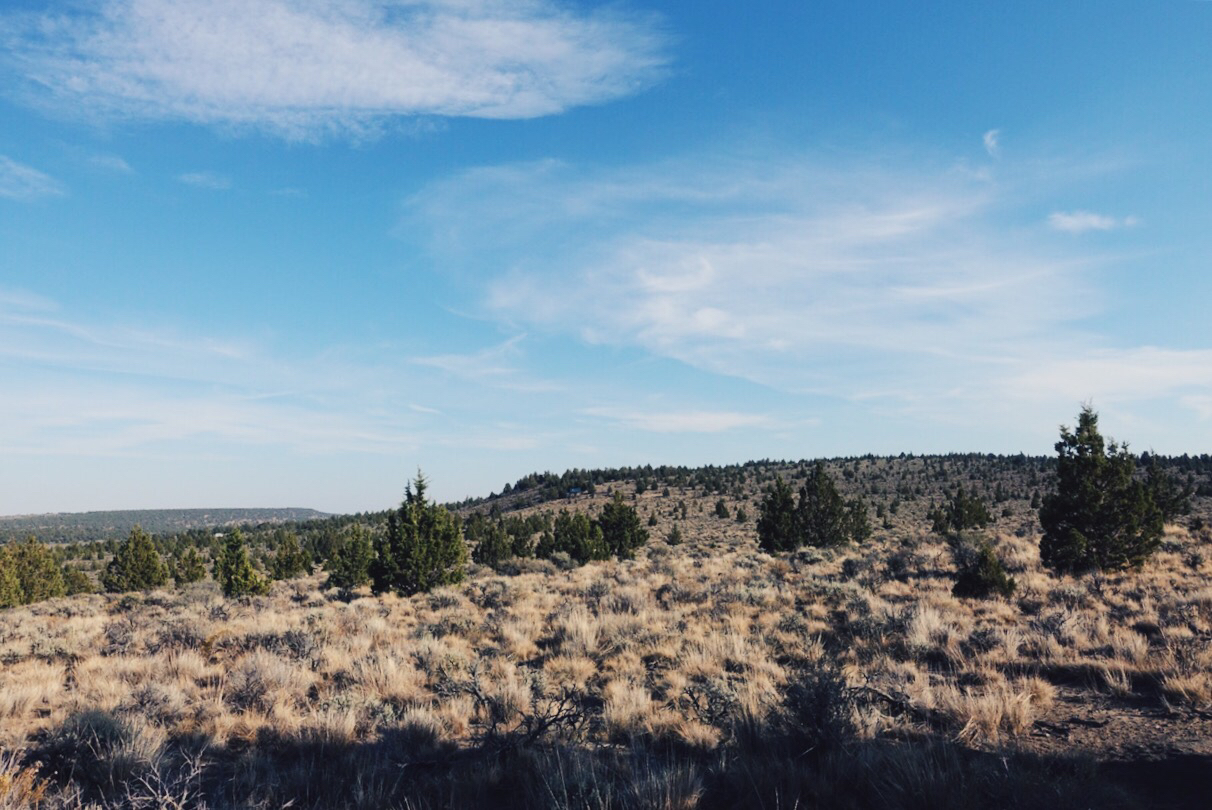
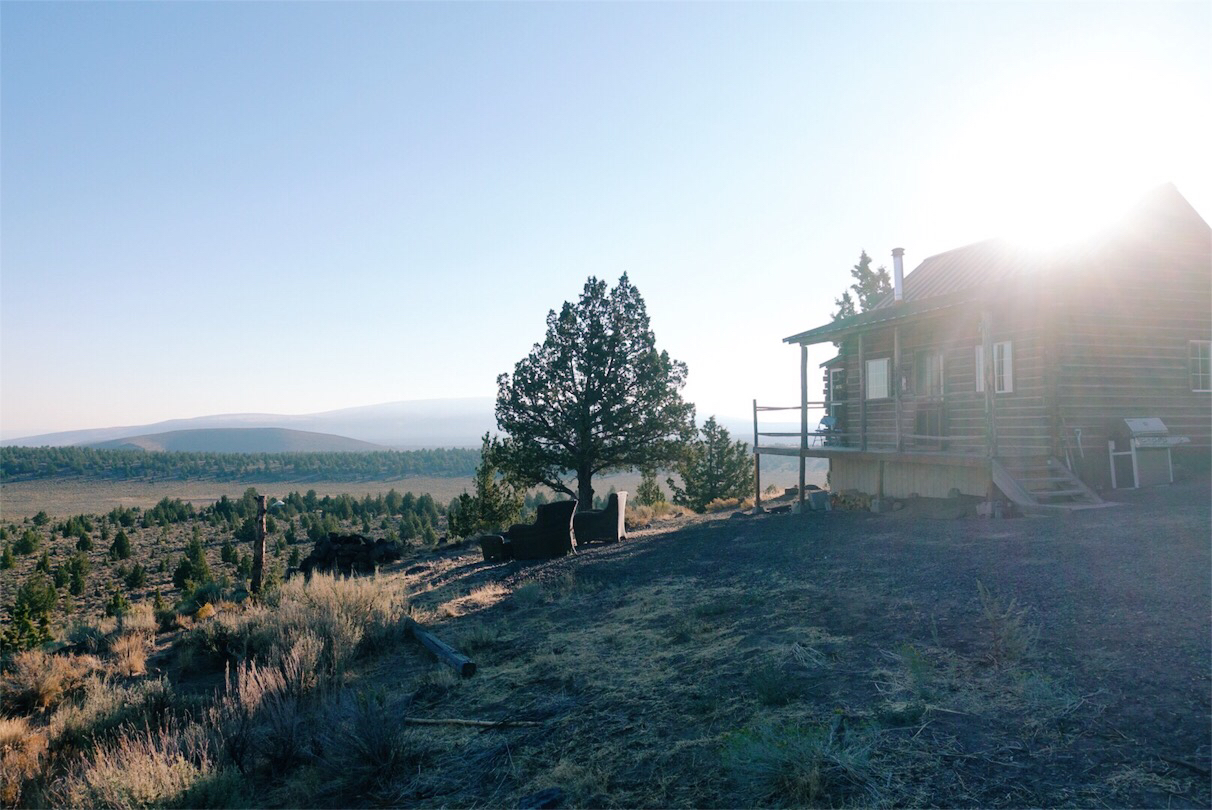
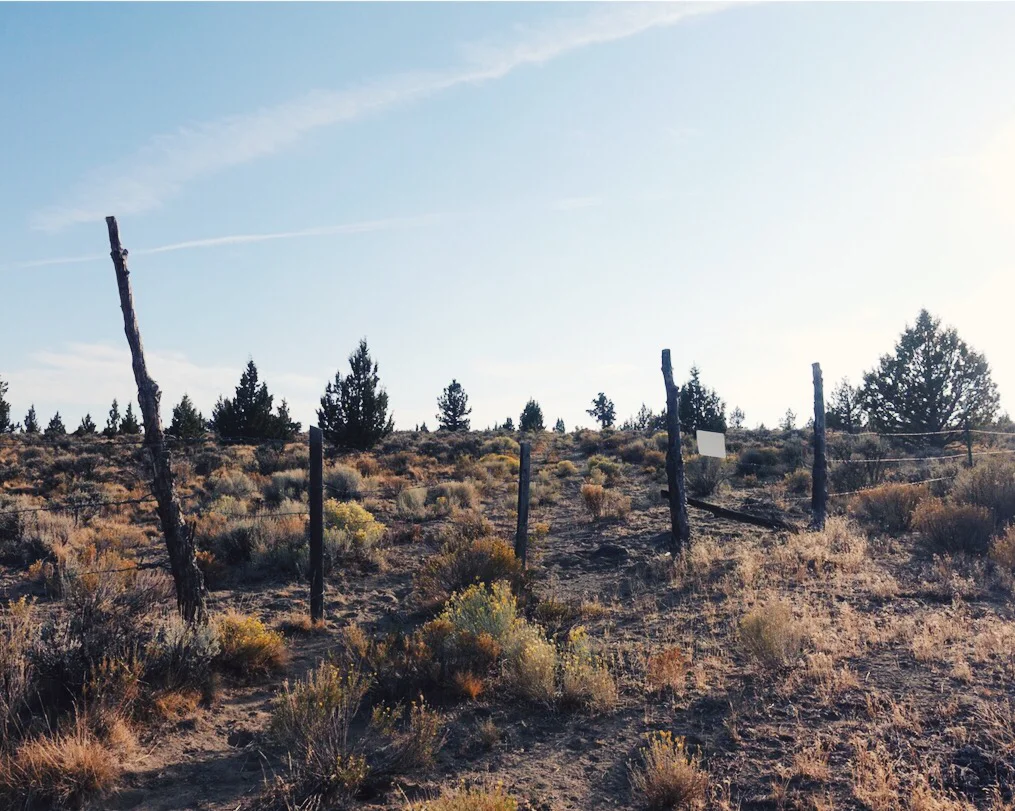
The cabin is perched on the high point of a rolling hill, from there, you can see the jackrabbit trails winding through the sagebrush. Down on the ground though, the trails are invisible.  I head out for a walk alone.  There is no destination to aim for, no obvious route to follow.  I keep the cabin in my sights and begin to wander.  After a half hour or so, I find an old dirt road.  It is criss-crossed with the tracks of dogs (or coyotes), the occasional set of elk prints.  No one has driven or walked it for a long time.  I follow it uphill to a barbed wire fence, then turn around and follow it downhill till I find another.  A mile away I can see the roof of the cabin shining in the sun.  I wave to it, wondering if my daughter is sitting on the porch, watching me amble around on roads that lead nowhere.  If I were doing this in the city, the French would have a word for me: flaneur - the stroller, the passionate wanderer.  Out here, I look more like a simpleton, coated in dust and sweat, stumbling into rabbit holes and over rocks, snagging my ankles on the prehistoric flora, walking uphill, then down.  But there is no one here but my daughter to see and she understands.  While I walk my mind unknots.  I can feel the muscles in my legs contracting and expanding, hear my breath pulling in and pushing out.  I am here.  I am alive.

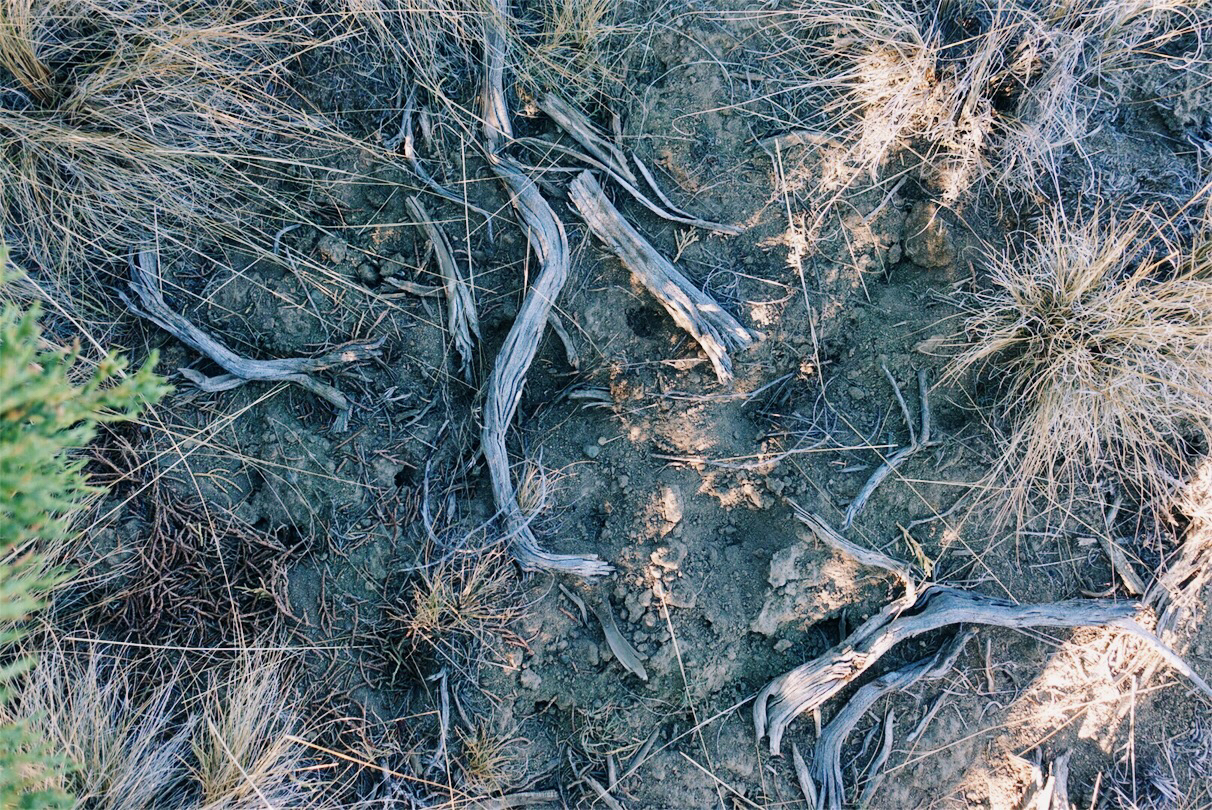
Just off the highway on the way to the cabin, we’d seen a hand-lettered sign on the side of the road.  “Beetle-Cleaned Skulls For Sale,” it read.  We were fresh from the city, sealed into our speeding car, dust-free, oblivious.  We looked at each other and laughed.  Who would want a beetle-cleaned skull?  That was ages ago, when I was young.  The sun is just descending into the western half of the sky, the landscape stretching unvaried before me, sage and grey and yellow-brown.  I search the ground, confident that in this liminal space I will find some bleached white testimony of a former life - a tibia, a jawbone, a knot of vertebrae.  Memento mori.  What is life without the awareness of death?  I find  the brittle grey bones of the sagebrush, and they crumble beneath my feet.

When it is time to leave the cabin and return home, we stand in the doorway, reluctance making us heavy and slow.  We are unshowered, grit in every crevice; we’ve eaten endless bowls of beans and rice; we have no idea of what is going on in the world outside the desert. At home we will be warm and clean and well fed.  There will be stories to tell and hugs to give, but we do not want to go.

“Supposing you only saw the stars once every year. Think what you would think,” said Tasha Tudor.  I do not have to think very hard.  How long since I saw the stars as I did in the desert?  A year?  A decade?   How long since I felt silence deep as water, slipped bodily into the stream of slow time?  Long, so long.  We clean the cabin, load up the car, stand in the dust and look out over the hills one last time, then once more.  "The wonder of it!"  I am here.  I am alive.  I make no resolve save to place myself here again and again.